I am reacting to an article I read on Medium that makes it seem like Adult Children are eternally righteous. This may be controversial, but I need to say this.
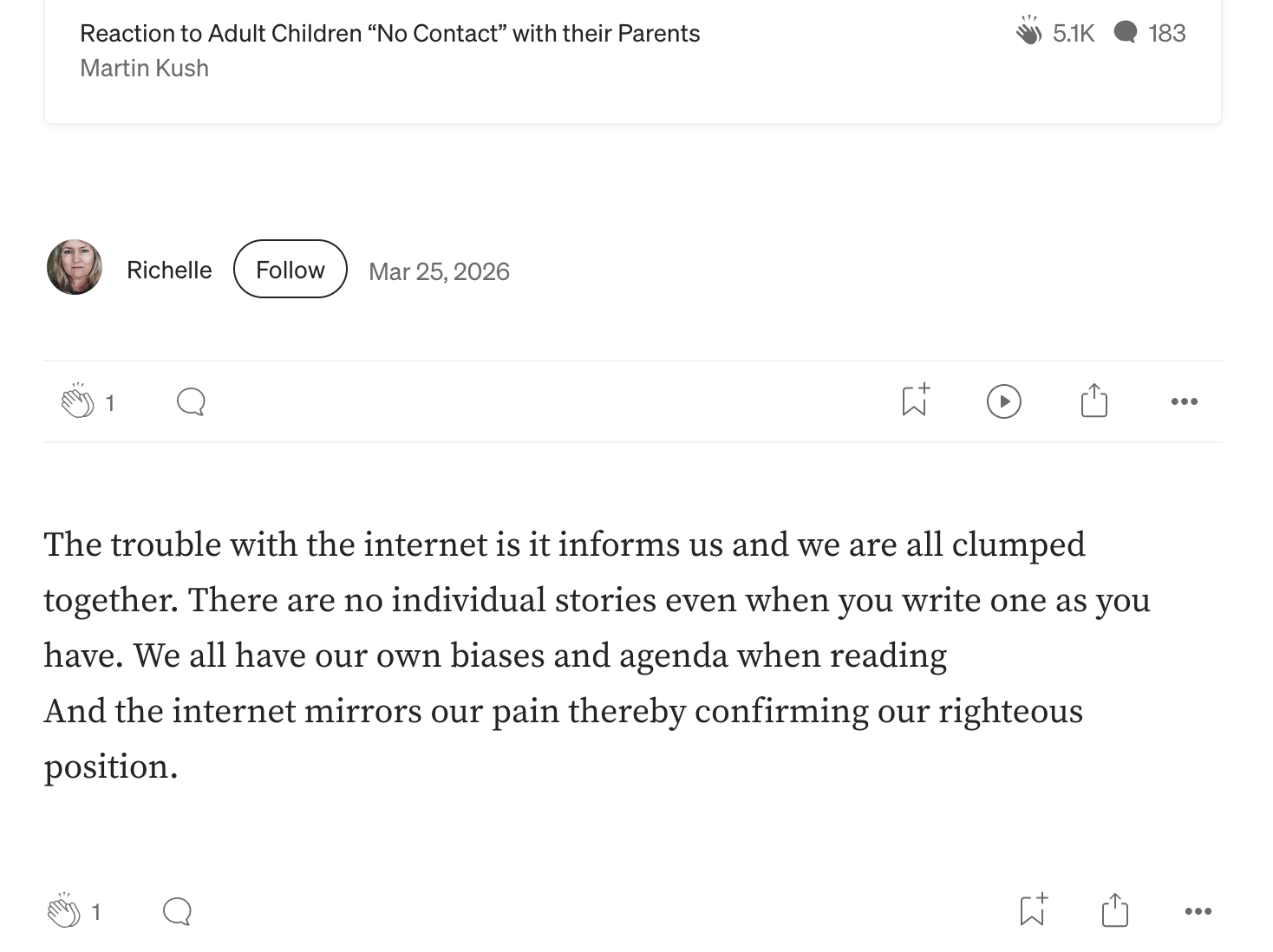
This article by Mona Lazar (someone I follow regularly and love her writing) articulates real pain that many adult children experience, and I don’t doubt that emotional abuse and chronic dysfunction drive many estrangements. I had less-than-perfect parents, too. I am estranged from my father mainly because he was never in my life. My mother, whom I loved dearly, passed away over 30 years ago when I was young. But the framing in Mona’s piece is dangerously one-sided, and it mirrors a broader problem in how we talk about family estrangement: we’ve turned it into a binary, like politics, where one party must be the villain and the other the victim, never any grey area or nuance. The world is always nuanced.
I’m a son. But I am also a parent who has experienced estrangement from two adult children (one is trying to reconnect to his credit) under very different circumstances. Their mother and I are divorced, and it was not smooth. She still wants me dead, and I know this because she said it to me, and to mutual friends. For the children, in one case, the estrangement followed my refusal to continue funding their lifestyle after depleting my retirement savings. I believed then that a parent should do whatever is necessary to help the child have even better opportunities. I have learned that parents should not set themselves on fire to keep others warm, not even their children. With another child, contact resumes only when money is needed. My daughter, whom I sent to boarding school to protect her from her mother’s abuse and narcissistic tendencies, now avoids both parents on her therapist’s advice. Sadly, she exhibits many of the same patterns I tried to shield her from. Laughs are on me, apparently!
I love my daughter. I miss her. I also recognize she hasn’t fully matured into understanding the complexity of what happened in our family. I am not blaming her. It’s just an observation. You see this in many families: people reach conclusions based on their own biases, without all the information or even caring about others’ circumstances that inform their decisions.
What troubles me about this discourse is the assumption that the adult child’s interpretation of the past is always more accurate than the parent’s. Memory is reconstructive. Therapy can help you see real patterns, but it can also help you construct narratives that flatten complicated, imperfect relationships into stories of abuse. Not every difficult childhood is an abusive one. Not every imperfect parent is a narcissist.
The therapy industry — yes, I label it as such — has economic incentives that rarely get examined. As an economist, I can’t help but see this. Therapists need clients. They need repeat clients. They get paid by the hour. They have bills, lifestyles, and vacations to finance. Estrangement is clean, fast, and easier to support than the slow, messy work of repair. I’m not saying all therapists operate this way, but the system rewards pathologizing relationships over salvaging them. You can’t save relationships via no contact. Add in pharmaceutical incentives, and you have a structure that benefits from keeping people stuck in their pain rather than helping them move through it, because in a capitalist system, we humans are the profit commodities.
Also, to boost the incentive system, we live in a culture of instant gratification. We expect same-day delivery, instant messages, swipe-right dating. Estrangement has become the relational equivalent: so, don’t like your family, huh? Cut them off. Feeling guilty? Hey, a therapist will validate you and make you feel good about your decision. We’ve made “boundaries” synonymous with “I don’t owe you anything,” and exiting family relationships has been rebranded as empowerment. I am not saying you should go hang out with your toxic family, but really, they don’t know anything about you, where you are, and you think that’s healthy? Absolutely, no contact?
You must remember that relationships aren’t consumer goods. You can’t return them or upgrade them. We are human beings, and planning and strategizing about our ways of survival, continuance, and growth happens via communication, even occasionally, if not regularly. The long game involves working through conflict, accepting imperfection, forgiving without forgetting, and deciding on the frequency of contact. But for the therapy industry, this approach doesn’t scale. It doesn’t monetize.
Here’s what doesn’t get said enough: “both sides can be telling the truth as they experienced it.” A parent can genuinely believe they loved and provided for their child. The child can genuinely feel unseen or controlled. Both can be right about their own experience and wrong about the other’s. Estrangement doesn’t resolve that gap. It freezes it. No talk, no resolution. We are stuck with the pain, something that only profits the therapists and the pharmaceutical industry.
The research cited in Mona’s article consistently centers the child’s narrative, but it rarely asks hard questions: How many of these estrangements are built on distorted or incomplete memories? How many are influenced by therapists with a hammer who see every family as a nail? How many adult children weaponize estrangement for leverage, money, or control?
Some parents are abusive. They are a human mess. Absolutely. This is true. But some adult children are also harmful, entitled, or unable to see beyond their own pain. The discourse refuses to hold space for that possibility.
I’ve had to accept that I can love my daughter and still protect myself. I can stay open to reconnection without staying available to be used. I can hope she matures and gains perspective without depending on it. That’s how I survive and protect my emotions because just as the adult children are human with feelings, so are the parents.
The estrangement narrative is broken because it insists on villains and victims. Real families are messier. You can be a good parent and still lose your child. You can be a wounded child and still harm the people who loved you. You can go to therapy for years and never heal.
This article names real pain. But it refuses to name real complexity. And that’s where the conversation needs to go if we’re ever going to move past taking sides. Thanks for reading. I hope this gives you food for thought.
An after note
This article was first published on Medium (January 17 2026) and gained quite a following for and against my thoughts and views on the subject of “no contact.” It became so polarizing that I felt to comment would have deepened my own depression about the issue. Some parents agreed with me, many therapist attacked my thoughts and views, and so did many adult children. Overall, it was mixed, many taking the space to express their own experience, and others just to misinterpret my article seen through their prism.
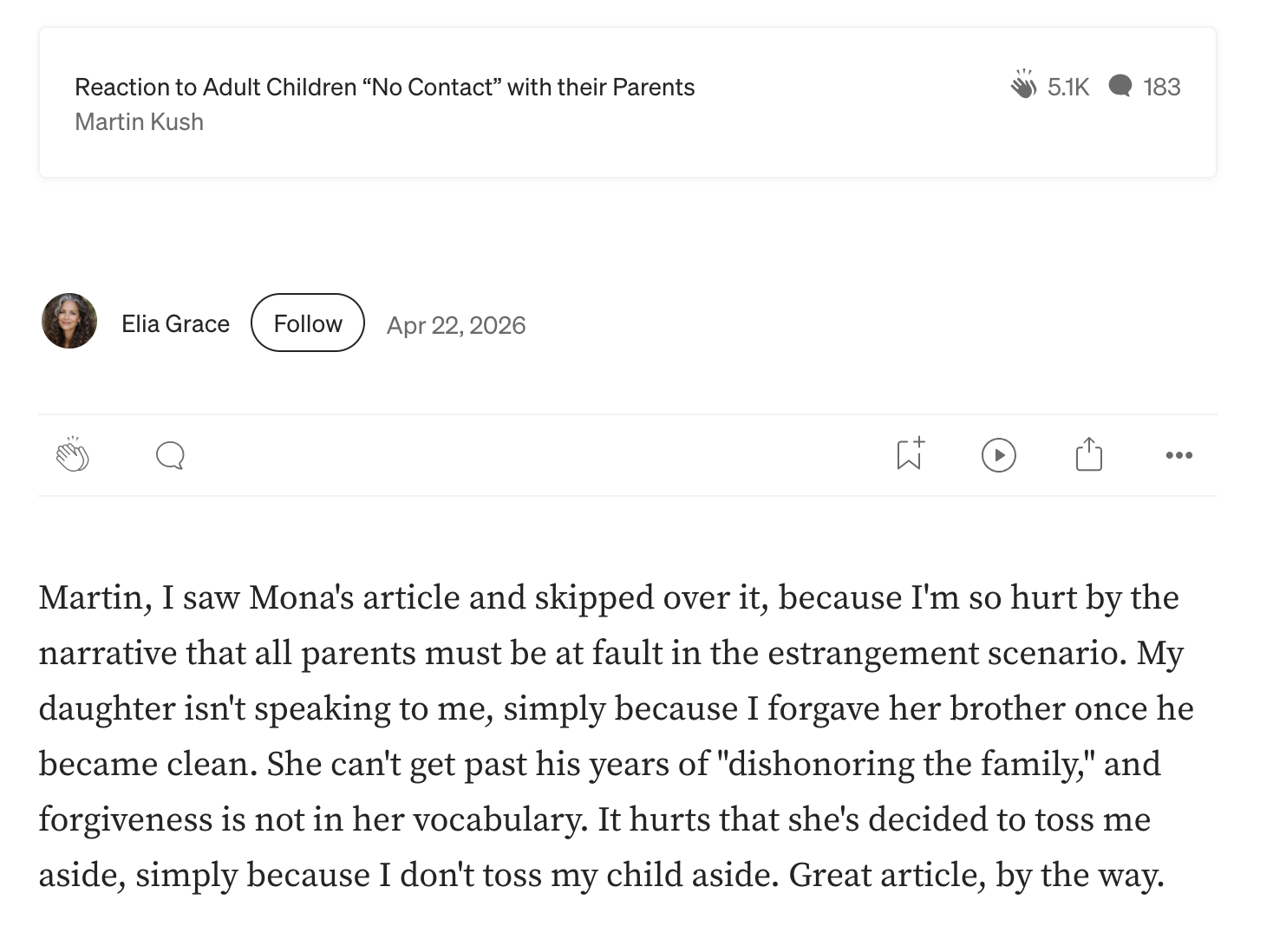
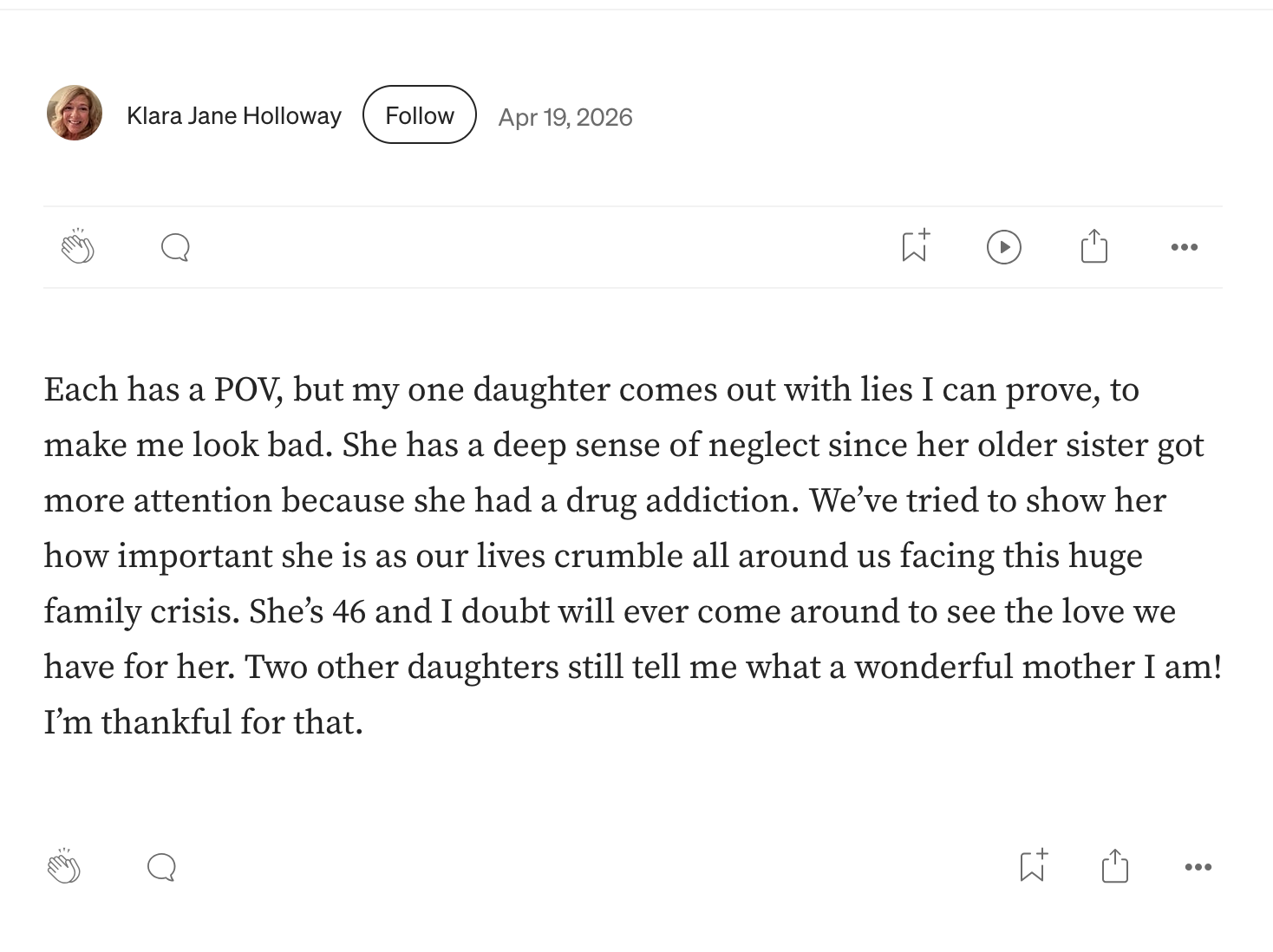
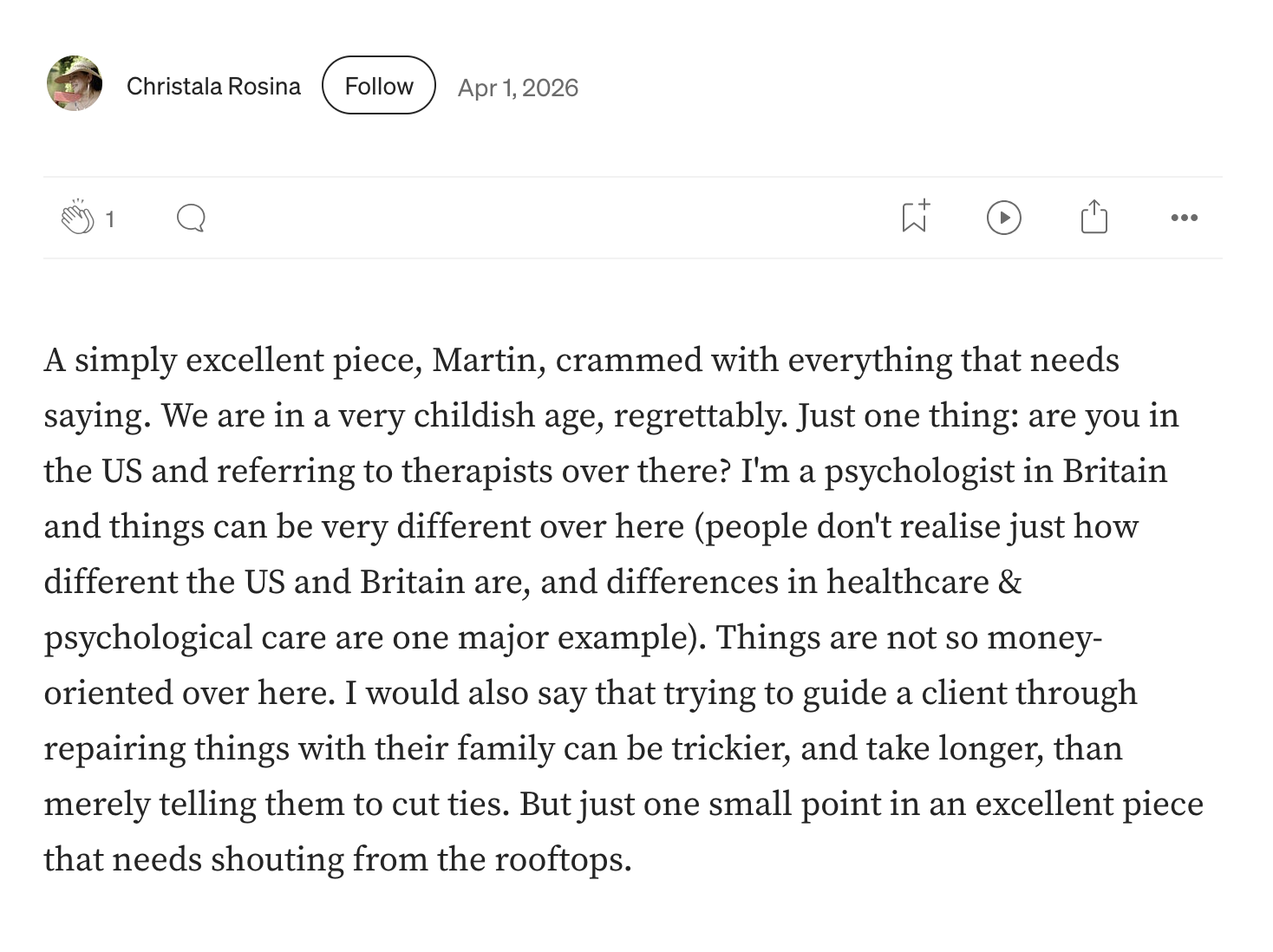
It’s a testament to how important this issue is and the pain it has caused many others suffering from the loss of connection with people they raised. If you are interested to read the comments, some of them inspiring, many heartbreaking to the point of despair, you can find the article here in this free (I think, unless Medium changes it) link. See some of them below.