
Why Some White Men Can’t Handle Fiction That Doesn’t Center Them
I recently listened to an interview with Cebo Campbell, the author of A Sky Full of Elephants—an eyebrow-raising, evocative novel by an African American writer that dares to imagine a world where the logic of European conquest is suddenly eradicated. Despite it being a work of fiction, I often get a “huh, wait, what?!” reaction from people when I tell them the premise of the book. But this piece is not so much about the book, but more about how certain people with power react to the very premise. What happened during the process of getting that fiction published intrigues me, so I want to examine this here. For me, it reveals something ugly and fragile about how whiteness operates. Although I am talking about publishing here, you will see this thread throughout my writings, books, and blog. In every aspect of life on this planet, there is an unnatural force that says everything should revolve around the imaginations of the so-called “default man.”
The author told a story about his literary agent—a white man—who felt “excluded” from the novel. He was not that offended. That would signal some remorse for the reason for the story. He was not at all confused. He got the gist of the fiction. He just felt excluded. He could not keep his thoughts a secret because every “default man” expects the world to conform to their imaginations of themselves. He confessed to the author that he couldn’t identify with anyone in the story. “No one like me is represented here,” he said. You might expect this complaint from a reader on an Amazon review. But this came from the man tasked with championing the book to the world. He gets paid for the success of this book. He is a gatekeeper. He is the person who develops the readers’ taste for this book. His bread-and-butter, is to be a merchant of stories. And yet here he was, wondering whether he should suppress the work because it didn’t mirror him.
That word—representation—is doing a lot of work here. Because when African Americans, Black, Indigenous, Hispanic, Asian, LGBTQ+, and other marginalized people talk about representation, it’s a demand for visibility, for access, for safety, for truth. But when white men talk about representation, it typically reveals a great panic: “If I’m not centered, am I even real? If I’m not the hero, am I the villain? Was everything society taught me a big, fat lie?”
The Psychology of White Absence
This is not a new psychology, but it is a revealing one. Always remember, no matter where in the world you are, whiteness is an identity structure, not a skin color, but a belief system. It is addicted to being omnipresent. It’s the narrator of misinformation in history, the face of capitalism, the symbol of order in Western storytelling. It expects to be in the middle of every scene, everywhere, and atop every hierarchy. So when whiteness isn’t present, it doesn’t just feel ignored—it feels erased. And it becomes manic. It panics.
In a way, it’s more than them feeling excluded. It’s about invalidation. Think about it this way. If the story doesn’t include them, doesn’t revolve around them, doesn’t even acknowledge them except as submerged corpses at the bottom of the ocean, then they are not in control. And, sadly, control is the entire project of whiteness.
You see, this agent is reacting to what he believes the novel represents. He was reacting to a worldview that didn’t need him. Here is a world, albeit fiction, that does not need white people, and it functions fine, maybe even better than with them. That terrified him.
The Bottom of the Ocean
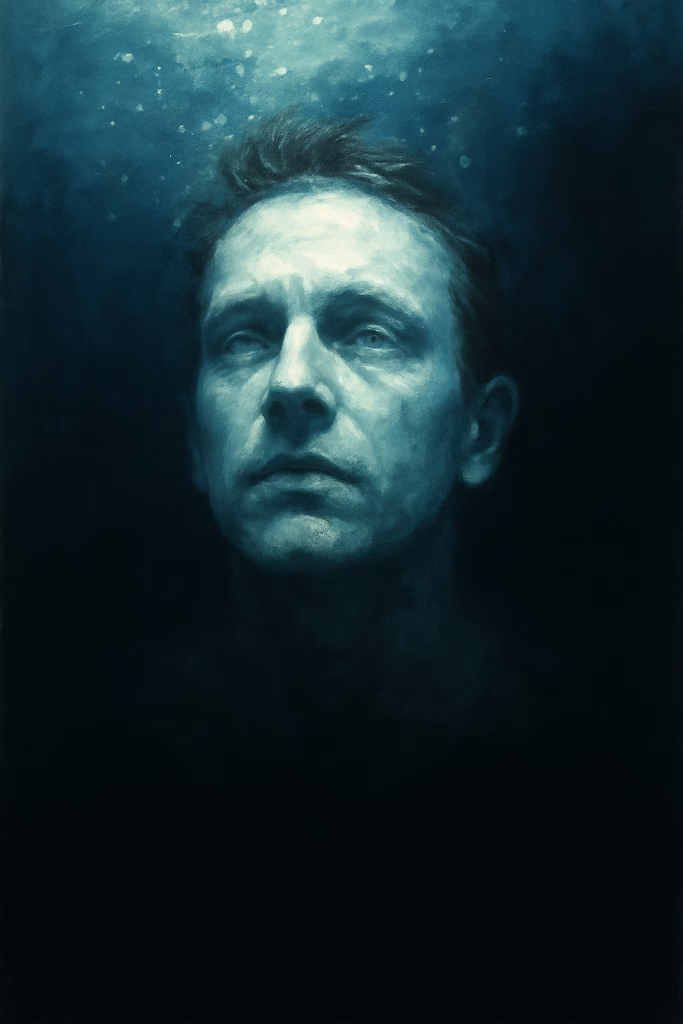
Cebo Campbell had what I thought was a fabulous response. He told the agent: “Oh, you’re in the book—you’re just at the bottom of the ocean.” That line landed like a Muhammad Ali knockout punch.
Because that is exactly the point of this novel—it submerged the empire. It reversed the gaze. It decentered the colonizer. And for a man so used to seeing himself as the center of attention, like a lighthouse, the idea of being the drowned shipwreck was intolerable.
And then there was the author’s Jewish manager, who also felt “hurt” by the implication. Why? Because he, too, had identified with whiteness. Whether by assimilation, by cultural conditioning, or by inherited privilege, he saw himself reflected in the very structures the novel critiqued. And rather than reject that affiliation, he mourned the blow to his ego. I found this bizarre because Jewish people have been attacked, murdered, displaced, and had all manner of persecution since I can recall history, at the hands of white Europeans. Why identify with your persecutors?
He had a choice: to see the destruction of whiteness as the liberation of humanity, including his humanity, or as a personal attack. He chose the latter.
The Problem Isn’t That He Wasn’t in the Book. It’s That He Couldn’t Imagine Not Being.
I think it’s worth reiterating a key fact here. The book is fiction. No one is owed inclusion in another person’s imagination. Yet somehow, this white agent believed that not being reflected in a Black author’s story was cause for hesitation—perhaps even rejection. Perhaps this book should not be published until the story follows the pattern he is accustomed to, focusing on people like him.
Meanwhile, Indigenous and Black authors have written in the margins for centuries. We have imagined futures where our people don’t die in the first chapter. I get tired of seeing movies with few Black characters who get killed off in the first act. We have fought for the right to name our own planets, build our own myths, and bury our own dead with dignity. But this man felt bruised by a story that didn’t center him.
That’s imperialism like a cancer on the brain.
Whiteness Is Not a Culture. It’s a Project.
Whiteness, historically, has no culture of its own. Like a sponge, it absorbs other cultures, swelling and heavy from the benefits derived from dominating them. The English, the French, the Portuguese, the Spanish, the Dutch, the Germans—they all built systems to monetize cultures, then erase or suppress whatever is left. The very structure of their operations has obliterated every people, civilization, environment, and religion they encountered. In America, whiteness was constructed as an organizing principle to divide, control, and erase. It feeds on hierarchy and narrative control.
So what happens when a story tells the truth about that erasure? What happens when the author says, “You’re in this—but not as the savior. You’re the ghost haunting the bottom of the sea”?
A few caring people listen. Some who are still concerned about being human will reflect on these issues.
But, most I have encountered just recoil. Because they’d rather burn a library and all its books than see themselves as the villain. Or even worse, irrelevant.
The Cost of Moral Imagination
What I find most disturbing is that both men in this story—the agent and the manager—were willing to question whether the book deserved success based on how they felt represented in its fictional world. They cared nothing about the readership or the ideas of the author. In other words, they were prepared to suppress a Black writer’s vision because it didn’t serve their internal fantasy of being decent, central, or saved.
That is the essence of gatekeeping. And it’s the death of moral imagination. It’s the reason many non-white authors don’t even get a chance to publish, or get their works publicized as many white authors do. My book, Economic Racism, is a typical example of one that is not promoted by a typical white-run publisher, so it is not widespread because of its theme of criticizing white systems as economically inferior.
Moral imagination requires the ability to empathize with people outside your tribe. It requires the humility to see yourself in the shadows, not always in the spotlight. It asks white people to stop expecting every story to make them feel good about themselves.
My Final Thought
The moment a white agent reads a book by a Black author and asks, “But where am I in this?”—he reveals his lack of imagination and his commitment to whiteness as a permanent protagonist. And the moment he considers suppressing the book because of that absence, he reveals his hideous insecurity. He’s dangerous.
You see, this manager, rather than see his job as promoting literature of any kind, sees his real role in life as guarding the empire of whiteness.
I love it that the author got this book published. The agent can skip this book. People like him should not read it. Let him read something else. Let him continue to read books that promote his fantasy. Let him sit with his discomfort at the bottom of his mental ocean, where centuries of stolen bones of brown people already rest.